Protist Facilitated Transport of Bacteria in the Rhizosphere
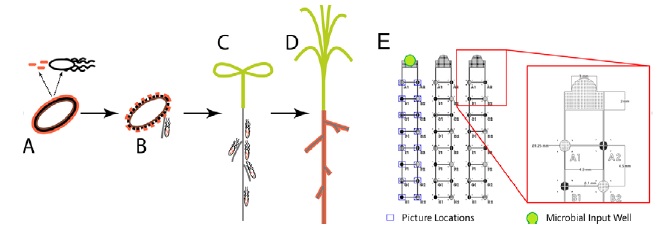 |
| Schematic of protist-facilitated dispersal of beneficial bacteria along growing crop roots. A. Bacteria (orange) and proto-zoa (black) are delivered in crop seed coatings. B. After planting, bacteria and protozoa are released from disintegrating seed coating, and protozoa take up bacteria internally or externally. C. Protozoa move along growing roots, where D bacteria are deposited, and may become established. E. Schematic of microdevice used to test protist-facilitated transport. |
Recently published articles:
The rhizosphere is the zone of soil surrounding plant roots that is under the influence of the root. Microbes in the rhizosphere that provide essential services for plant hosts include nitrogen fixing bacteria and biocontrol strains that protect roots from pathogens. The primary weakness of conventional biocontrol technology is the failure to deliver enough functional bacteria to critical locations. Beneficial bacteria added as a soil treatment often fail to survive and proliferate and/or fail to colonize growing roots. Furthermore, even if biocontrol bacteria do attach to an emerging root, seedling roots grow very quickly from the tip, such that biocontrol bacteria become dilute along the root length.1 Improved compositions and methods are needed for targeted delivery of biocontrol bacteria and other agricultural payloads to vulnerable root tips of actively-growing plants.
We propose to use soil protists for spatial distribution of beneficial bacteria along crop roots. Our research will extend protist-facilitated transport beyond beneficial bacteria: we feel this technology can be used for targeted delivery and controlled release of a wide range of lipo-some-encapsulated agrochemicals. UConn recently filed a patent on the technology, and we have been in discussions with potential industry partners in-cluding DuPont/Pioneer.
People Involved: Grant Bouchillon, Brian Cruz, Rebecca Rubenstein
Collaborators: Dr. Dan Gage
Funding: Bill and Melinda Gates Foundation, Grand Challenges Exploration Program
Humphris, S. N. et al. Root cap influences root colonisation by Pseudomonas fluorescens SBW25 on maize. Fems Microbiology Ecology 54, 123-130, doi:10.1016/j.femsec.2005.03.005 (2005).
Rubinstein*, RL, AL Kadilak*, VC Cousens**, DJ Gage, LM Shor. Protist-facilitated particle transport using emulated soil micromodels. (Environmental Science & Technology)