Microbe-Habitat Interaction
With support of an NSF grant, we are developing microbial habitat arrays that replicate micro-scale physical, chemical & biological habitat features. The devices allow direct, real-time observation of microbial responses including migration, replication, substrate utilization, and behavior.
Microfluidic devices provide reproducible, adaptable, micro-structured settings for hypothesis-driven microbial research.

Example microfluidic devices created at the Vanderbilt Institute for Integrative Biosystems Research and Education (VIIBRE) by Phil Samson, Dmitry Markov, John Wikswo, and Leslie Shor
Microfluidic Devices
Devices can be created with nearly limitless features including stable or transient concentration gradients, small reaction volumes, and complex physical structures like those found in real microbial habitats in the environment, industry, and medicine. Microfluidic devices also offer real-time, high-resolution 4-D measurement of multiple optical signals.
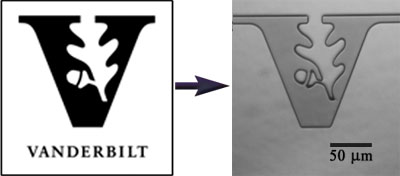
Pictured is a microfluidic device of the vanderbilt logo created at VIIBRE by David Schaffer and Nick Luibrand. Design by Adit Dhummadupt and Leslie Shor.
EcoChip participants and advisors include Joseph Dolan, David Kosson, Eugene LeBoeuf, Dmitry Markov, Phil Samson, David Schaffer, Gary Taghon, Steve Tuorto, John Wikswo and Lily Young.
Undergraduate students include Vanessa Allwardt, Amanda deVillers, Adit Dhummakupt, Jennifer Greene, Kathleen Grunder, Nicholas Luibrand, John Mallard, John Montemurro, Samuel Nackman, and Samantha Sabatino.